Advanced Energy Storage perspective, From Conventional Lithium-ion to Vapor-Deposited Thin-Film Batteries
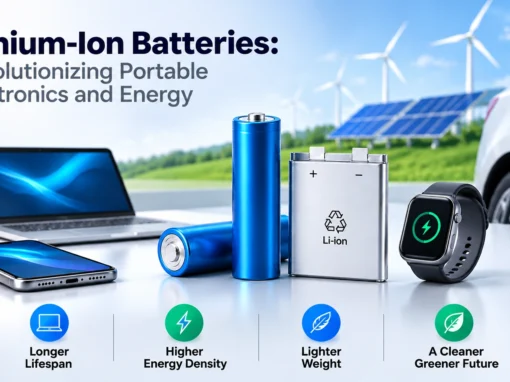
Lithium-ion (Li-ion) batteries have revolutionized portable electronics and are rapidly transforming the automotive and grid energy storage sectors. Their unique electrochemical properties enable high-efficiency energy storage, making them indispensable in today's technology-driven economy. Understanding both their remarkable performance benefits and inherent manufacturing challenges highlights why vacuum-based thin-film innovation is critical for next-generation energy storage.
Key Characteristics of Conventional Lithium-ion Technology
The global dominance of Li-ion batteries stems from key performance advantages that decisively outshine legacy chemistries such as nickel-cadmium (Ni-Cd) and lead-acid.
Performance Comparison Metrics:
Such performance advantages are rooted in several critical metrics that directly influence engineering design. First, conventional Li-ion cells deliver an exceptional energy density of 150 to 200 Wh/kg. This high density enables highly compact, lightweight footprints while extending single-charge runtimes.
Additionally, they feature a remarkably low self-discharge rate of just 1% to 2% per month, ensuring excellent charge retention and shelf-life during prolonged periods of inactivity. In terms of durability, their service life spans from hundreds to thousands of cycles, delivering long-term operational reliability for consumer electronics, electric vehicles (EVs), and grid storage systems.
However, while conventional Li-ion technology offers these exceptional performance metrics, it also introduces distinct engineering, economic, and safety challenges.
Major Advantages
- High Specific Energy: Maximizes energy storage capacity relative to total system weight.
- Low Maintenance: Eliminates the "memory effect" entirely, requiring no periodic deep-discharge cycles.
- Industrial Versatility: Scalable across diverse fields, from micro-medical implants to heavy electric drivetrains.
Key Disadvantages
- Capital-Intensive Production: High initial material sourcing and complex manufacturing costs.
- Thermal Instability: Vulnerability to catastrophic thermal runaway under mechanical abuse, overcharging, or extreme ambient temperatures.
- Supply Chain Sustainability: Environmental and ethical concerns surrounding the mining of critical raw materials like lithium, cobalt, and nickel.
Conventional Lithium-Ion Battery Fabrication
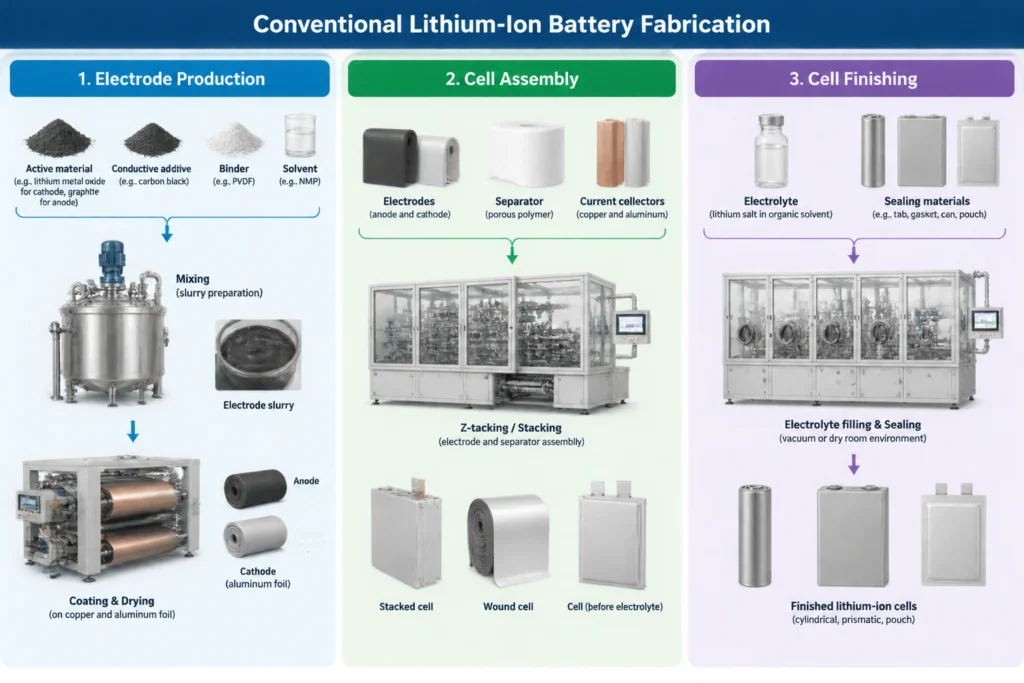
Traditional Li-ion manufacturing relies heavily on wet electrochemical processes split into three core production stages:
- Electrode Production: Active materials, conductive carbon additives, and polymeric binders (e.g., PVDF) are mixed with a volatile organic solvent (e.g., NMP) into a viscous slurry. This slurry is coated onto metal foil current collectors (copper for the anode, aluminum for the cathode), passed through high-temperature drying ovens, and calendered to achieve uniform thickness and target density.
- Cell Assembly: Conducted inside specialized low-dewpoint dry rooms. Electrodes are slitted and either wound or Z-stacked with a porous polymer separator. Tabs are welded to the current collectors, and the assembly is housed in a pouch, cylindrical, or prismatic casing. The cell is then filled with a liquid organic electrolyte under a vacuum.
- Cell Finishing: The sealed cell undergoes formation (the initial, controlled charge/discharge cycles that electrochemically develop the protective Solid Electrolyte Interphase [SEI] layer at the anode interface). Cells are aged to monitor self-discharge, undergo rigorous quality testing, and are graded by capacity and internal resistance.
The Shift to vacuum Thin-Film Deposition
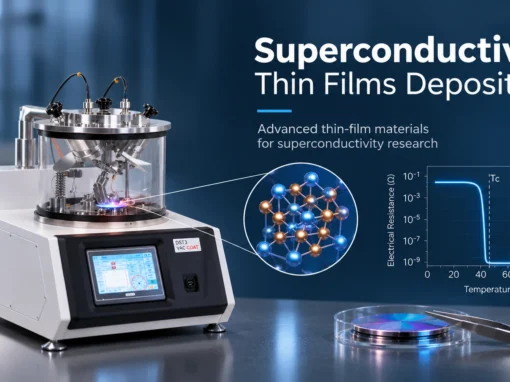
First demonstrated in 1969, thin-film deposition bypasses the messy, defect-prone chemistry of conventional slurry casting. Researchers turn to methods like Physical Vapor Deposition (PVD) and Atomic Layer Deposition (ALD) to completely eliminate volatile liquid components and binders, resolving material impurities, mechanical instabilities, and chemical degradation.
Thin-film manufacturing is currently deployed via two distinct architectural pathways:
Pathway A: Solid-State Micro-Batteries (Alternative Architecture)
- Description: The entire battery stack—including current collectors, anode, solid electrolyte, and cathode—is sequentially deposited in a vacuum chamber.
- Key Attributes: Utilizes solid-state electrolytes like Lithium Phosphorus Oxynitride (LiPON) to replace liquid variants. The total stack thickness is often under 20 microns, creating highly flexible, exceptionally safe micro-power sources for IoT sensors and medical implants.
Pathway B: Pre-Lithiation Additive (Conventional Enhancement)
- Description: Rather than replacing the battery architecture, a sacrificial, ultra-thin layer of pure lithium metal is vacuum-deposited directly onto traditional graphite or silicon anodes.
- Key Attributes: This serves as a targeted additive step that compensates for the irreversible lithium loss during the initial cell formation cycle, boosting the net energy density of otherwise conventionally manufactured batteries.
Mitigating Performance Degradation via Thin-Films
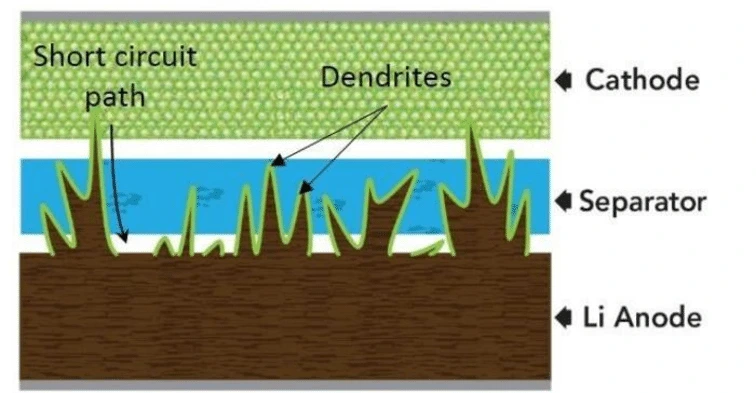
| Liquid-Electrolyte Drawback: 1- Continuous SEI Thickening: Liquid electrolytes continuously decompose against active materials, creating an increasingly thick SEI layer that permanently traps active lithium and drives up internal resistance. 2- Dendritic Short-Circuits & Flammability: Volatile liquid solvents pose extreme fire risks. Liquid media also allow crystalline lithium "dendrites" to pierce the polymer separator, causing catastrophic internal short-circuits. 3- High Interfacial Resistance: Thick, particulate-based slurry layers maximize the diffusion distance for lithium ions, causing high interface resistance and voltage drops during fast charging. |
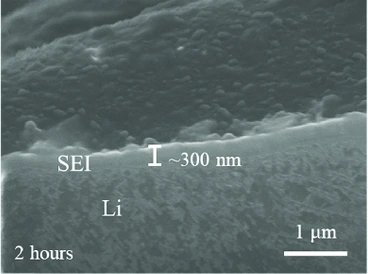
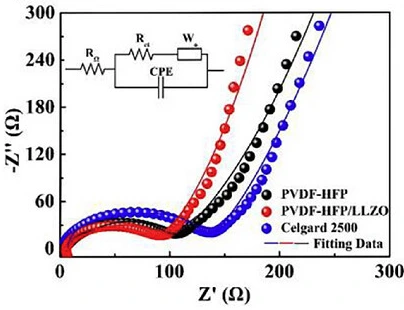
| Thin-Film Vapor Deposition Solution: 1- Solid-State Electrolyte Stability: Thin-film processes utilize dense, ultra-pure solid electrolytes (e.g., LiPON) that maintain chemical stability against lithium, eliminating continuous electrolyte consumption. 2- Dense Solid Barrier Mechanicals: Vapor deposition yields structurally dense, uniform ceramic barrier layers that mechanically suppress dendrite propagation, eliminating internal shorting and fire risks. |
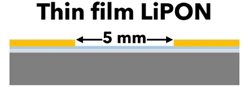
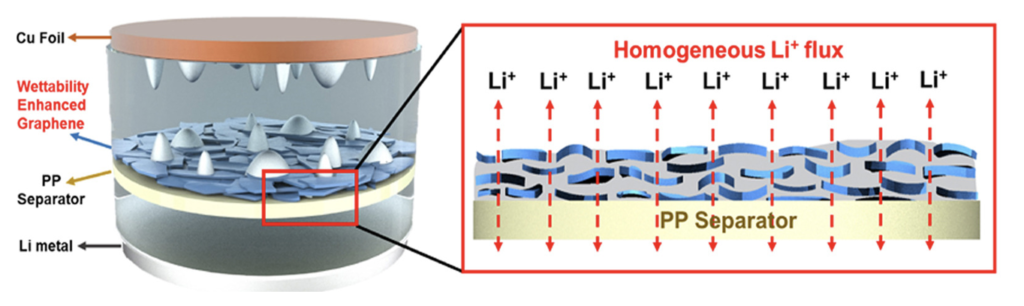
3- Atomically Smooth Interfaces: Vacuum-deposited layers possess highly uniform microstructures and an ultra-thin stack profile (<1 μm to 10 μm). This drastically compresses ion transport distances, enabling rapid diffusion and a cycle life extending up to 50,000 cycles.
Focus Technique: Thermal Evaporation for Lithium Films
High-Vacuum Vaporization Dynamics
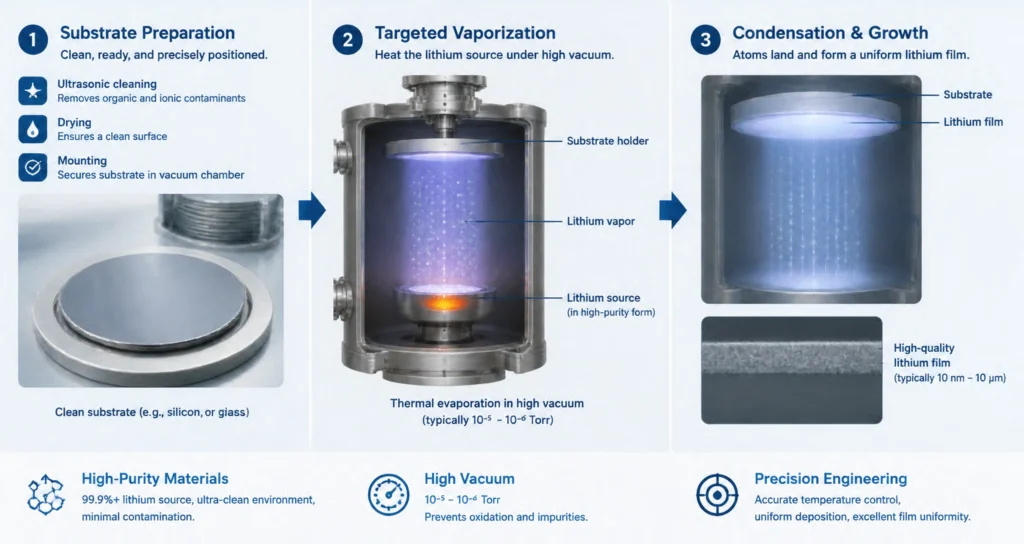
Thermal evaporation under high vacuum (10-5 to 10-6 Torr) is the premier PVD variant for processing low-melting-point, highly reactive metals like lithium. This bridges semiconductor precision with high-performance battery engineering [10].
Core Processing Stages and Substrate Condensation
- Substrate Preparation: High-purity current collectors (e.g., 10--20 μm copper foil) or solid ceramic electrolytes are mounted inside the vacuum chamber.
- Source Vaporization: High-purity solid lithium source material is placed into a specialized boat (constructed of tungsten, tantalum, or iron). The boat is resistively heated to 400–500°C. Because lithium vaporizes cleanly at low temperatures, the process prevents thermal deformation of thin substrate foils.
- Condensation & Growth: Evaporated lithium atoms travel via line-of-sight molecular flow, condensing atom-by-atom onto the cooled substrate to build a highly uniform, dense metallic layer.
Structural Benefits Over Mechanically Rolled Lithium Foils
Traditional lithium foils manufactured via mechanical rolling and extrusion rarely achieve thicknesses below 20-50 μm, creating substantial "dead weight" lithium. Thermal evaporation resolves this through:
- Ultra-Thin Anodes: Easily deposits precise profiles ranging from 50 nm up to 10 μm, minimizing dead volume and significantly increasing volumetric energy density.
- Contaminant-Free Interfaces: Avoids the native oxides (Li₂O), hydroxides (LiOH), and carbonates (Li₂CO₃) typical of commercially ambient-rolled foils, allowing for an incredibly clean, homogenous interface.
- Planar Morphology: The smooth, pinhole-free deposition layout prevents localized electric field concentrations, ensuring uniform ion flux and suppressing dendrite nucleation sites.
Critical Technical Constraints & Implementation
Despite its profound structural advantages, scaling vacuum thermal evaporation faces severe engineering hurdles:
- The Shadowing Effect: Being a strictly line-of-sight vapor technique, thermal evaporation easily coats planar sheets but fails to uniformly coat complex, high-surface-area 3D porous current collectors.
- Atmospheric Sensitivity (Glovebox Integration): The entire vacuum evaporation system must be hermetically integrated inside a high-purity argon-filled glovebox environment. Trace exposure to moisture or CO₂ instantly reacts with the fresh vapor-deposited lithium, forming insulating contaminant layers.
- Throughput Scalability: Transitioning a high-vacuum batch technique into a continuous, high-throughput, roll-to-roll (R2R) assembly line for automotive-scale batteries demands massive, highly capital-intensive investments compared to traditional wet-slurry casting equipment.
Emerging Battery Architectures Powered by Evaporation
Solid-State Batteries (SSBs)
In Solid-State Batteries, thermal evaporation is used to deposit lithium directly onto solid ceramic (such as LLZO) or sulfide-based electrolytes. The key operational benefit of this process is that it achieves intimate, atomic-level contact at the solid-to-solid interface, which significantly reduces internal interfacial impedance.
Anode-Free (Lithium-Free) Cells
For anode-free cells, this technique involves pre-depositing a sub-micron "seed layer" or an artificial Solid Electrolyte Interphase (SEI) modifier directly onto bare copper foil. This approach successfully regulates the initial overpotential and nucleation barrier, ensuring that subsequent electrochemical lithium plating during runtime remains uniform and completely dendrite-free.
Thin-Film Micro-Batteries
In thin-film micro-batteries, the technology enables the sequential, multi-layer vacuum stack deposition of all active components onto a single substrate. This manufacturing method delivers highly stable, leak-proof, and safe micro-footprints designed to safely power microelectronics, medical implants, and smart sensors.
Application Guide: Lithium Deposition for Battery Fabrication
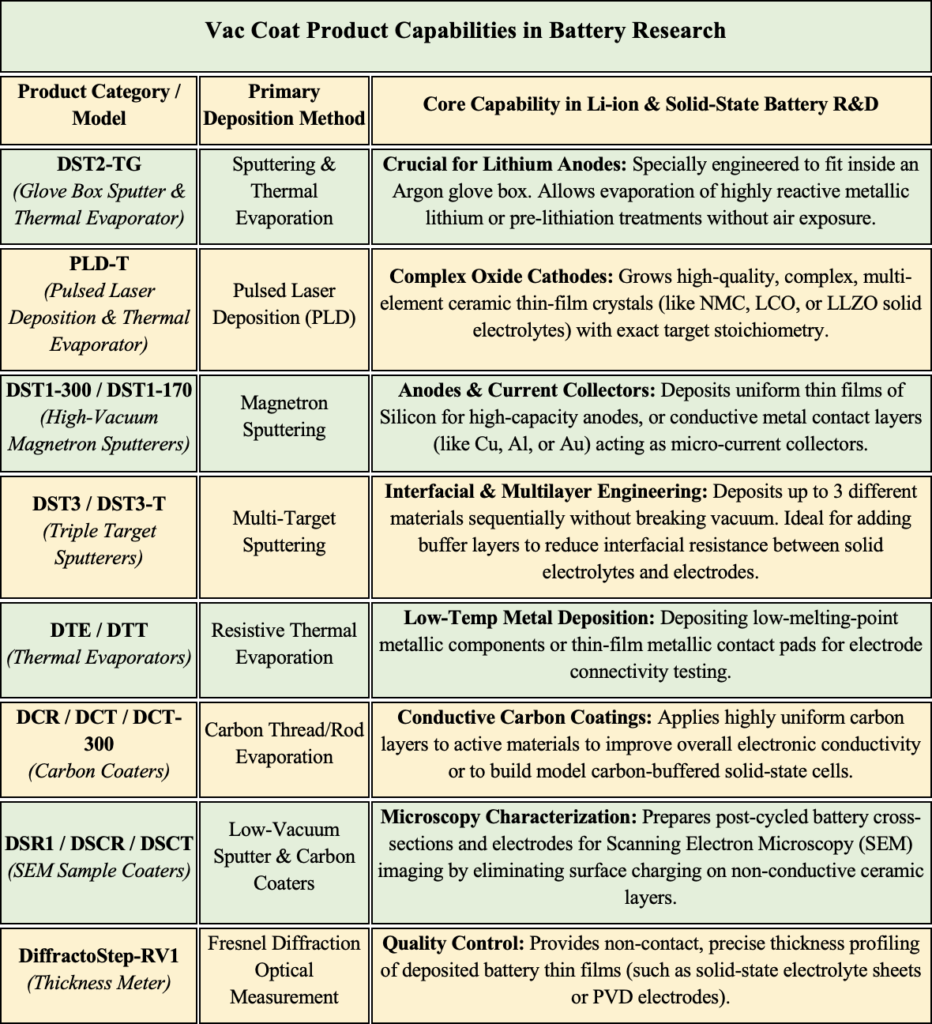
The high-vacuum thermal evaporation deposition systems manufactured by Vac Coat Ltd. are ideal for depositing thin lithium layers during advanced battery fabrication. Depending on your specific substrate size and layer requirements, the technology is available in two distinct configurations:
• Vac Coat DTE (Desktop Model): This compact, low-budget system utilizes a smaller 170 mm diameter chamber. It is optimized for short-cycle, fast-vacuuming runs and is perfect for pre-depositing sub-micron lithium seed layers or artificial SEI modifiers on substrates up to 2 inches in diameter.
• Vac Coat DTT (Large Chamber Model): If your process requires larger substrates (exceeding 2 inches), multi-layer vacuum stacks, or a multi-source thermal setup to prevent chamber damage during extended runs, the upgraded DTT model features a larger 300 mm diameter chamber equipped with three thermal sources to accommodate scaling needs.
Both systems offer clean, oil-free high-vacuum environments (<5 × 10⁻⁶ Torr) powered by an integrated turbo molecular pump, ensuring zero oil contamination on highly reactive lithium films.
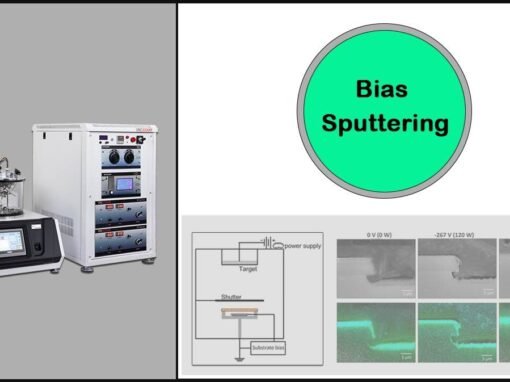
In addition to anode and cathode preparation, other physical vapor deposition techniques like magnetron sputtering are heavily utilized across various stages of lithium-ion and solid-state battery fabrication. For instance, in their investigation into solid-state batteries, Pachulska et al. utilized the DSR1 Desk Sputter Coater developed by Vac Coat. This automated DC magnetron sputtering system, equipped with a quartz crystal thickness monitor, enables researchers to deposit highly uniform, fine-grained thin films of noble metals—ideal for creating precise electrical contacts, current collectors, or protective conductive layers on battery specimens.
The table below outlines the specific Vac Coat system models and their targeted applications within the battery fabrication, interface engineering, and material characterization workflows:
Conclusion
The evolution of lithium-based energy storage highlights a critical shift from conventional slurry-casted architectures to precise, vapor-deposited configurations. While conventional liquid-electrolyte lithium-ion batteries remain the bedrock of modern portable electronics and electric mobility, their reliance on wet chemical production processes introduces unavoidable material non-homogeneity, chemical impurities, and severe long-term degradation. Issues such as continuous, resistance-inducing SEI thickening, electrolyte flammability, and catastrophic dendritic short-circuits place a fundamental ceiling on the safety and cycle life limits of standard battery formats.
Vacuum-based thin-film deposition—driven by physical vapor deposition (PVD) and atomic layer deposition (ALD) techniques—offers a robust paradigm to systematically mitigate these performance bottlenecks. By substituting volatile liquid components with stable, dense solid electrolytes like LiPON, or by deploying precise pre-lithiation additives, thin-film manufacturing enables binder-free architectures characterized by atomically smooth, low-resistance interfaces. Specifically, processing highly reactive lithium metal via high-vacuum thermal evaporation bridges semiconductor-level manufacturing precision with electrochemical cell engineering. This precise technique successfully produces ultra-thin, contaminant-free, and structurally planar anodes that significantly boost volumetric energy density while suppressing the localized electric fields that trigger dendrite growth.
Transitioning these vacuum procedures from low-throughput batch environments into automotive-scale, continuous roll-to-roll (R2R) production lines presents profound engineering constraints. Line-of-sight shadowing effects over complex porous matrices and hyper-sensitive requirements for hermetic glovebox integration represent intensive capital and infrastructure hurdles. Nevertheless, as research untangles these throughput bottlenecks, thermal vapor evaporation remains a foundational pillar for next-generation energy storage. By establishing immaculate interfaces and precise thickness control, thin-film deposition is central to unlocking the commercial viability of exceptionally safe, long-lasting all-solid-state, anode-free, and micro-battery architectures.
References
1- A. K. Haruna, S. G. Al-Khafaji, and M. A. Hussein, "Advancing energy storage: The future trajectory of lithium-ion battery technologies," Journal of Energy Storage, vol. 102, p. 113941, Jan. 2025.DOI: 10.1016/j.est.2025.116511. [Online]. Available: https://www.sciencedirect.com/science/article/pii/S2352152X25012241
2- E. M. Al-Anazi, T. R. Al-Otaibi, and K. M. Naidu, "A review on the recent advances in battery development and energy storage technologies," International Journal of Energy Research, vol. 2024, Article ID 2329261, May 2024. [Online]. Available: https://onlinelibrary.wiley.com/doi/10.1155/2024/2329261
3- F. Schomburg et al., “Lithium-ion battery cell formation: status and future directions towards a knowledge-based process design,” Energy Environ. Sci., vol. 17, no. 8, pp. 2686–2733, 2024, doi: 10.1039/D3EE03559J.
4- C. Liang, J. Epstein, and G. H. Boyle, “A High-Voltage, Solid-State Battery System: II. Fabrication of Thin-Film Cells,” J. Electrochem. Soc., vol. 116, no. 10, pp. 1452–1454, 1969, doi: 10.1149/1.2411560.
5- K. Lim, B. Fenk, J. Popovic-Neuber, and J. Maier, “Porosity of Solid Electrolyte Interphases on Alkali Metal Electrodes with Liquid Electrolytes,” ACS Appl. Mater. Interfaces, vol. 13, Oct. 2021, doi: 10.1021/acsami.1c15607.
6- Sumbulla, Analysis of Prevailing Battery Innovations and Concept Technologies, 2022. doi: 10.13140/RG.2.2.17752.83201
7- K. Vishweswariah, N. G. Ningappa, A. Kumar M. R., J. I. G. Dawkins, T. M. G. Selva, and K. Zaghib, “Advanced Separators for Liquid and Quasi-Solid Lithium Rechargeable Batteries: Design and Development,” Adv. Mater., vol. 38, no. 30, Art. no. e73124, 2026, doi: 10.1002/adma.73124.
8- S. J. Turrell, Y. Liang, T. Cai, B. Jagger, and M. Pasta, “Origin of Stability in the Solid Electrolyte Interphase formed between Lithium and Lithium Phosphorus Oxynitride,” Chem. Mater., vol. 37, no. 9, pp. 3504–3518, May 2025, doi: 10.1021/acs.chemmater.5c00483.
9- W. Choi et al., "Towards ultra-stable and dendrite-suppressed Li-metal batteries: Ion-regulating graphene-modified separators," Carbon, vol. 230, p. 119576, Nov. 2024, doi: 10.1016/j.carbon.2024.119576.
10- Kurt J. Lesker Company, "Lithium Li Evaporation Process Notes," Kurt J. Lesker Company. Available: https://www.lesker.com/newweb/deposition_materials/deposition-materials-notes.cfm?pgid=li1. [Accessed: Oct. 12, 2026].
11- A. S. Westover, R. Sahore, K. L. Browning, and S. Kalnaus, "Thermal evaporation of thin Li films," J. Vac. Sci. Technol. B, vol. 43, no. 2, p. 022401, 2025. doi: 10.1116/6.0004174
12- K. Pachulska, M. Malys, P. Michalski, M. Krynski, A. Cuper, M. Trzaskowski, M. Winkowska-Struzik, and M. Struzik, "Tuning Ionic and Electronic Transport in Cubic Li7La3Zr2O12 through Dual-Site Doping with Mixed-Valence Cations: Nb, Pr, and Ni/Co," Chem. Mater., vol. 38, no. 9, pp. 4601–4613, May 2026, doi: 10.1021/acs.chemmater.5c03505