Pressure Gauges

Pressure Gauges

Report, Vacuum Coating System
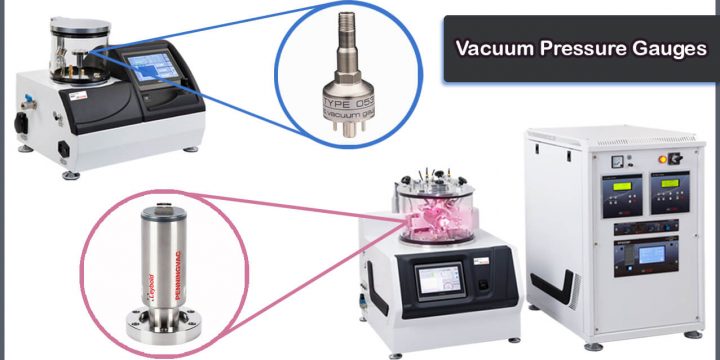
[vc_row][vc_column width="3/4"][vc_row_inner][vc_column_inner][vc_column_text] Pressure Gauges Pressure, force per unit area (N/m2), is identified as the applied force by a fluid (gas or liquid) to a surface. Pressure measurement has many applications in everyday life. For decades, tools used to measure and display pressure are known as Pressure Gauges or Vacuum Gauges. A vacuum gauge can measure the pressure ranges lower than the ambient pressure. Generally, the pressure is not an absolute quantity, and most pressure gauges determine the pressure compared to the atmospheric pressure as the reference. [/vc_column_text][/vc_column_inner][/vc_row_inner][vc_row_inner css=".vc_custom_1736607959621{background-color: #D9D9D9 !important;}"][vc_column_inner width="1/2"][vc_cta h2="" txt_align="center" style="3d" color="mulled-wine" add_button="bottom" btn_title="High Vacuum Systems" btn_style="3d" btn_color="juicy-pink" btn_align="center" css="" btn_link="url:https%3A%2F%2Fvaccoat.com%2Fblog%2Fultra-high-vacuum-systems%2F|title:High%20Vacuum%20and%20Ultra-High%20Vacuum%20Systems|target:_blank"][/vc_cta][/vc_column_inner][vc_column_inner width="1/2"][vc_video link="https://www.youtube.com/watch?v=NvCDu54y__k" css=""][vc_column_text css=".vc_custom_1736607933583{margin-top: -20px !important;}"] Introduction to vacuum technology [/vc_column_text][/vc_column_inner][/vc_row_inner][vc_row_inner][vc_column_inner][vc_column_text] Pressure Regions and Pressure Types The vacuum pressure is defined in three regions: low vacuum…
Read More
Plasma Treatment in Microfluidics

Plasma Treatment in Microfluidics

Report
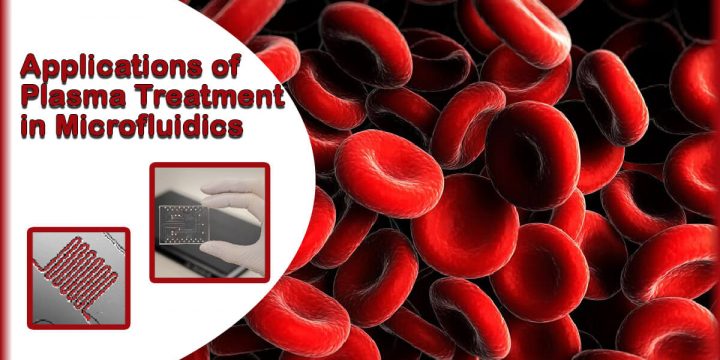
[vc_row][vc_column width="3/4"][vc_row_inner][vc_column_inner][vc_column_text css=""] Applications of Plasma Treatment in Microfluidics Plasma is the fourth state of matter, and in today’s high technology, is being used widely in many fields such as electrical engineering, optics, printing, painting, medical, mechanical, and textile. Plasma treatment is used to improve the surface properties of a broad range of materials by cleaning the contaminants from surfaces before manufacturing processes and functionalizing the surfaces with large quantities of reactive chemical species. [/vc_column_text][/vc_column_inner][/vc_row_inner][vc_row_inner css=".vc_custom_1736609103063{background-color: #D9D9D9 !important;}"][vc_column_inner width="1/2"][vc_cta h2="" txt_align="center" style="3d" color="mulled-wine" add_button="bottom" btn_title="Plasma Treatment" btn_style="3d" btn_color="juicy-pink" btn_align="center" css="" btn_link="url:https%3A%2F%2Fvaccoat.com%2Fblog%2Fvacuum-plasma-vacuum-plasma-treatment%2F|title:Vacuum%20Plasma%20%7C%20Vacuum%20Plasma%20Treatment|target:_blank"][/vc_cta][/vc_column_inner][vc_column_inner width="1/2"][vc_video link="https://youtu.be/94tReSbyPYc" css=""][vc_column_text css=".vc_custom_1736609088324{margin-top: -20px !important;}"] What is plasma? [/vc_column_text][/vc_column_inner][/vc_row_inner][vc_row_inner][vc_column_inner width="1/2"][vc_column_text css=""] The plasma pre-treatment process raises the surface energy and results in disinfection, cleanness, and modification of surfaces to prepare them for adhesive bonding, and coating processes. In…
Read More
Co-Deposition Techniques

Co-Deposition Techniques

Deposition, Report, Sputter Coater, Sputtering, Thermal evaporation, Thin Film
[vc_row][vc_column width="3/4"][vc_row_inner][vc_column_inner][vc_column_text] Co-Deposition Techniques in Vac Coat Coaters After the scientific revolution driven by nanotechnology, nanocomposites, and hybrid materials with many applications play a vital role in modern science and technology research. These kinds of materials offer electrical and mechanical properties, optical interaction, and thermal conductivity with very high efficiency. The vital part of nanocomposites research is choosing the best way to prepare these complex materials. Co-Deposition Techniques indicates a procedure with two, three, or more deposition sources. Thus, these different or same sources react together and coat on the desired samples to provide alloys and hybrids with excellent characteristics. [/vc_column_text][/vc_column_inner][/vc_row_inner][vc_row_inner css=".vc_custom_1735820520286{background-color: #D9D9D9 !important;}"][vc_column_inner width="1/2"][vc_cta h2="" txt_align="center" style="3d" color="mulled-wine" add_button="bottom" btn_title="What is PVD?" btn_style="3d" btn_color="juicy-pink" btn_align="center" btn_link="url:https%3A%2F%2Fvaccoat.com%2Fblog%2Fphysical-vapor-deposition-pvd%2F|title:Physical%20Vapor%20Deposition%20(PVD)|target:_blank"][/vc_cta][/vc_column_inner][vc_column_inner width="1/2"][vc_cta h2="" txt_align="center" style="3d" color="mulled-wine" add_button="bottom" btn_title="What is Deposition?" btn_style="3d" btn_color="juicy-pink" btn_align="center" css=""…
Read More
Vacuum Plasma | Vacuum Plasma Treatment

Vacuum Plasma | Vacuum Plasma Treatment

Report
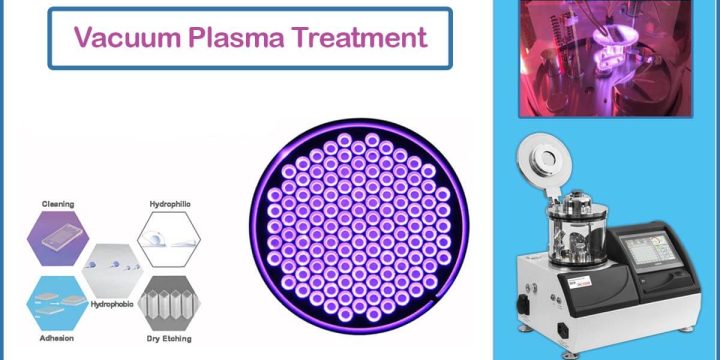
[vc_row][vc_column width="3/4"][vc_row_inner][vc_column_inner][vc_column_text css=""] What Is Vacuum Plasma Treatment? Plasma as the fourth state of matter introduced in 1927 by Langmuir, is observable in various places, from Vacuum plasma in a glow discharge tube in a lab to lightning and flames in the atmospheric presuure. Vacuum plasma treatment is a common method for creating surfaces with desired properties through coating, cleaning, etching, surface activation and functionalization. Plasma can be generated by applying an electric current across a dielectric gas (arcing) or increasing the gas temperature by heating (like a flame) to take out the electrons from atoms and ionizing the gas, making it conductive. These charged particles can affect the electrical characteristics of the gas or be manipulated by external electric/magnetic fields. [/vc_column_text][/vc_column_inner][/vc_row_inner][vc_row_inner css=".vc_custom_1736684354128{background-color: #D9D9D9 !important;}"][vc_column_inner width="1/2"][vc_cta h2="" txt_align="center" style="3d" color="mulled-wine"…
Read More
Glow Discharge Plasma Cleaning and Applications

Glow Discharge Plasma Cleaning and Applications

Report
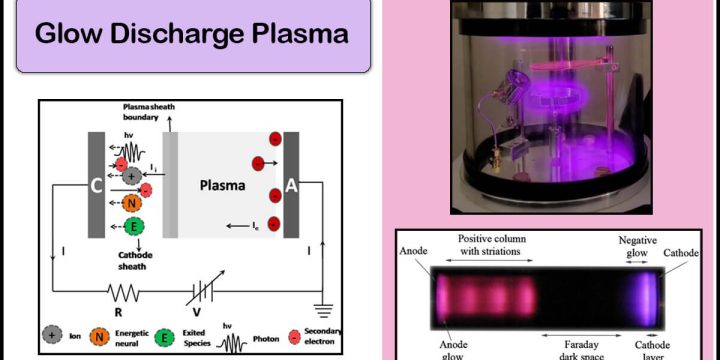
[vc_row][vc_column width="3/4"][vc_row_inner][vc_column_inner][vc_column_text css=".vc_custom_1693484733942{margin-right: 30px !important;margin-left: 30px !important;}"] Glow Discharge Plasma Cleaning Plasma created by the electric discharge of a gas between two electrodes in a low-pressure chamber is called glow discharge plasma. Glow discharge happens when free plasma electrons recombines with positive ions and emit photons. This phenomenon lies between the dark discharge region with low current ionization and no light emission, and arc discharge with large radiations (Figure 1). Glow discharge plasma contains energetic ionized gases species, which can be used for different purposes, cleaning a surface or coating it, as sputtering deposition method. [/vc_column_text][/vc_column_inner][/vc_row_inner][vc_row_inner][vc_column_inner][vc_single_image image="7411" img_size="large" add_caption="yes" alignment="center" style="vc_box_outline" border_color="mulled_wine" onclick="zoom"][/vc_column_inner][/vc_row_inner][vc_row_inner css=".vc_custom_1736700150128{background-color: #D9D9D9 !important;}"][vc_column_inner width="1/2"][vc_column_text css=".vc_custom_1736700202160{margin-right: 30px !important;margin-left: 30px !important;}"] DC Glow Discharge Plasma Formation The subsequent collisions between gas species, like electrons, ions, and neutral atoms between two…
Read More
Desk Sputter Coater and Carbon/Thermal Evaporator in One New System

Desk Sputter Coater and Carbon/Thermal Evaporator in One New System

News
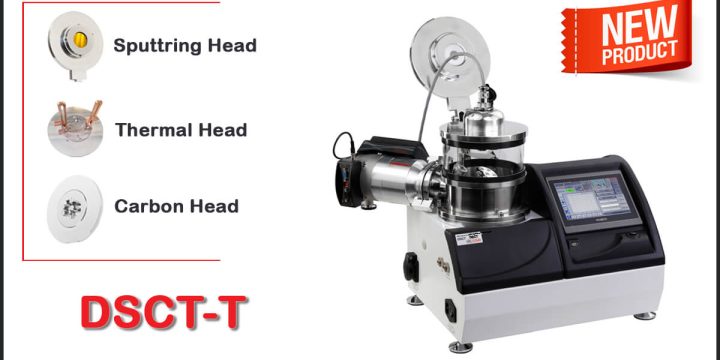
[vc_row][vc_column width="3/4"][vc_row_inner][vc_column_inner][vc_column_text css=""] Desk Sputter Coater and Carbon/Thermal Evaporator in One New System In recent months, the R&D team of Vac Coat Ltd. has developed strategies based on science and engineering to design and manufacture a new product titled DSCT-T. This versatile coating system equipped with a turbomolecular vacuum pump allows coating in three methods: sputtering, thermal evaporation of carbon, and thermal evaporation of metals in one system. The Desk Sputter Coater and Carbon/Thermal Evaporator has a mini-size design that saves valuable laboratory space. [/vc_column_text][/vc_column_inner][/vc_row_inner][vc_row_inner][vc_column_inner width="1/2"][vc_cta h2="" txt_align="center" style="3d" color="mulled-wine" el_width="xl" add_button="bottom" btn_title="Know more about Turbomolecular Pump" btn_style="3d" btn_color="juicy-pink" btn_align="center" btn_link="url:https%3A%2F%2Fvaccoat.com%2Fblog%2Flearn-more-about-turbomolecular-pumps%2F|title:Learn%20More%20about%20Turbomolecular%20Pumps|target:_blank"][/vc_cta][/vc_column_inner][vc_column_inner width="1/2"][vc_cta h2="" txt_align="center" style="3d" color="mulled-wine" el_width="xl" add_button="bottom" btn_title="What is Sputtering?" btn_style="3d" btn_color="juicy-pink" btn_align="center" btn_link="url:https%3A%2F%2Fvaccoat.com%2Fblog%2Fsputtering%2F|title:Sputtering%20Process%20%7C%20Sputtering%20Deposition%20Method|target:_blank"][/vc_cta][/vc_column_inner][/vc_row_inner][vc_separator][vc_row_inner][vc_column_inner][vc_column_text] The Desk Sputter Coater and Carbon/Thermal Evaporator – DSCT-T, a new customized version of the DSCT (Turbo…
Read More
How can I protect a Turbomolecular Vacuum Pump?

How can I protect a Turbomolecular Vacuum Pump?

Report, Vacuum Coating System, Vacuum Pumps
[vc_row][vc_column width="3/4"][vc_row_inner][vc_column_inner][vc_column_text css=""] How can I protect a Turbomolecular Pump? There is a wide range of mechanical pumping techniques that perform medium vacuum and provide long-time trustworthiness. However, to create High Vacuums (HV) and Ultra-High Vacuum (UHV) for advanced scientific and technological fields which are required in thin-film fabrication devices such as Thermal Evaporation Coating Devices, Sputtering Coaters, Carbon Coaters, Pulsed Laser Deposition (PLD) and the manufacturing processes of layer deposition require for solar cells, semiconductors, optical filters, magnetic sensors, and scanning electron microscope (SEM) sample preparation a turbomolecular vacuum pump with the most highly engineered design is necessary. [/vc_column_text][/vc_column_inner][/vc_row_inner][vc_row_inner css=".vc_custom_1736767774956{background-color: #D9D9D9 !important;}"][vc_column_inner width="1/2"][vc_cta h2="" txt_align="center" style="3d" color="mulled-wine" add_button="bottom" btn_title="Sputter Coaters" btn_style="3d" btn_color="juicy-pink" btn_align="center" btn_link="url:https%3A%2F%2Fvaccoat.com%2Fsputter-coater%2F|title:Sputter%20Coaters%20%7C%20High%20Resolution%20Sputtering%20System|target:_blank"][/vc_cta][/vc_column_inner][vc_column_inner width="1/2"][vc_cta h2="" txt_align="center" style="3d" color="mulled-wine" add_button="bottom" btn_title="Learn more about PLD" btn_style="3d" btn_color="juicy-pink" btn_align="center" btn_link="url:https%3A%2F%2Fvaccoat.com%2Fblog%2Fwhat-is-pulsed-laser-deposition-pld%2F|title:What%20is%20Pulsed%20Laser%20Deposition%20(PLD)%3F|target:_blank"][/vc_cta][/vc_column_inner][/vc_row_inner][vc_row_inner][vc_column_inner][vc_column_text css=""]…
Read More
DSCR-300 New Customize Desk SEM Coater

DSCR-300 New Customize Desk SEM Coater

News
[vc_row][vc_column width="1/4"][vc_wp_posts number="10"][/vc_column][vc_column width="3/4"][vc_row_inner][vc_column_inner][vc_column_text] DSCR-300 New Customize Desk SEM Coater   Vac Coat Company, one of the market leaders in coating systems, is pleased to announce a new customize Desk SEM Coater with a 300 mm diameter vacuum chamber which is suitable for SEM sample preparation and Micro & Nanoelectronic. [/vc_column_text][/vc_column_inner][/vc_row_inner][vc_row_inner][vc_column_inner width="1/2"][vc_cta h2="" txt_align="center" style="3d" color="mulled-wine" el_width="xl" add_button="bottom" btn_title="Sputter Coater" btn_style="3d" btn_color="juicy-pink" btn_align="center" btn_link="url:https%3A%2F%2Fvaccoat.com%2Fsputter-coater%2F|title:Sputter%20Coaters%20%7C%20High%20Resolution%20Sputtering%20System|target:_blank"][/vc_cta][/vc_column_inner][vc_column_inner width="1/2"][vc_cta h2="" txt_align="center" style="3d" color="mulled-wine" el_width="xl" add_button="bottom" btn_title="Sample Preparation For SEM" btn_style="3d" btn_color="juicy-pink" btn_align="center" btn_link="url:https%3A%2F%2Fvaccoat.com%2Fblog%2Fsample-preparation-for-sem%2F|title:Sample%20Preparation%20for%20Scanning%20Electron%20Microscopy|target:_blank"][/vc_cta][/vc_column_inner][/vc_row_inner][vc_separator][vc_row_inner][vc_column_inner][vc_column_text]For your larger samples and routine lab work: Desk Sputter & Carbon Coater, DSCR-300, is a reliable thin film deposition solution that will pay back your investment smoothly. The DSCR-300 has a larger chamber, ideally suited for coating a single large diameter specimen up to 6″ (150 mm) or multiple smaller samples…
Read More
Upgrading the Sample Planetary Rotation System

Upgrading the Sample Planetary Rotation System

Sputter Coater, Sputtering, Thermal evaporation, Thin Film
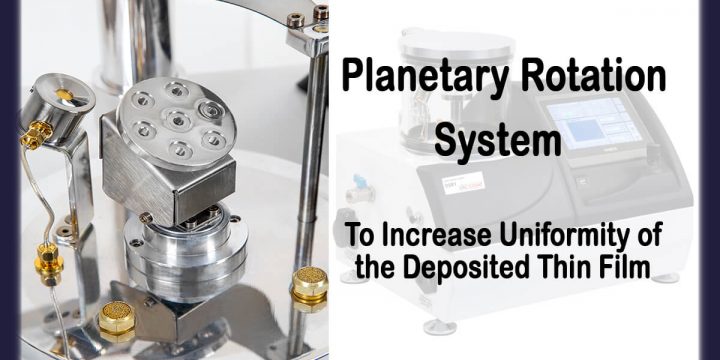
[vc_row][vc_column width="3/4"][vc_row_inner][vc_column_inner][vc_column_text css=""] Upgrading the Sample Planetary Rotation System One of the characteristics of a suitable thin film is the degree of uniformity of the deposited layer. Rotation of the substrate during coating is one of the most effective ways to increase the uniformity of thin film deposited in the Physical Vapor Deposition (PVD) method. The effectiveness of substrate rotation in improving the uniformity of the deposited thin film depends on the geometry of the substrate and how it rotates during the coating process. For example, in the case of substrates with a flat geometric shape (such as a disk), rotation about an axis perpendicular to the surface of the substrate is sufficient to create a uniform layer on it. [/vc_column_text][/vc_column_inner][/vc_row_inner][vc_row_inner css=".vc_custom_1736770592549{background-color: #D9D9D9 !important;}"][vc_column_inner width="1/2"][vc_cta h2="" txt_align="center" style="3d" color="mulled-wine" add_button="bottom"…
Read More
Physical Vapor Deposition (PVD)

Physical Vapor Deposition (PVD)

Deposition, Report
[vc_row][vc_column width="3/4"][vc_row_inner][vc_column_inner][vc_column_text] Physical Vapor Deposition (PVD) Physical Vapor Deposition (PVD) is a set of vacuum deposition methods in which a solid material vaporizes in a vacuum environment and is deposit on the substrate as a thin film. The most common methods of PVD are Sputtering and Thermal Evaporation. Because in the PVD process, the material is transported and accumulated atom-by-atom or molecule by molecule in a vacuum to the substrate surface, the deposited films have high purity and efficiency that for many applications compared to other deposition methods are preferred. [/vc_column_text][/vc_column_inner][/vc_row_inner][vc_row_inner css=".vc_custom_1713698950630{background-color: #d9d9d9 !important;}"][vc_column_inner width="1/2"][vc_video link="https://youtu.be/I_RnlLafVt0"][vc_column_text css=".vc_custom_1713698898755{margin-top: -20px !important;}"] What is PVD coating? [/vc_column_text][/vc_column_inner][vc_column_inner width="1/2"][vc_cta h2="" txt_align="center" style="3d" color="mulled-wine" el_width="lg" add_button="bottom" btn_title="Read more about Sputtering" btn_style="3d" btn_color="juicy-pink" btn_align="center" btn_link="url:https%3A%2F%2Fvaccoat.com%2Fblog%2Fsputtering%2F|title:Sputtering%20Process%20%7C%20Sputtering%20Deposition%20Method|target:_blank"][/vc_cta][/vc_column_inner][/vc_row_inner][vc_row_inner][vc_column_inner width="1/2"][vc_column_text css=".vc_custom_1689857428683{margin-top: 40px !important;}"] For example, in the construction of the…
Read More