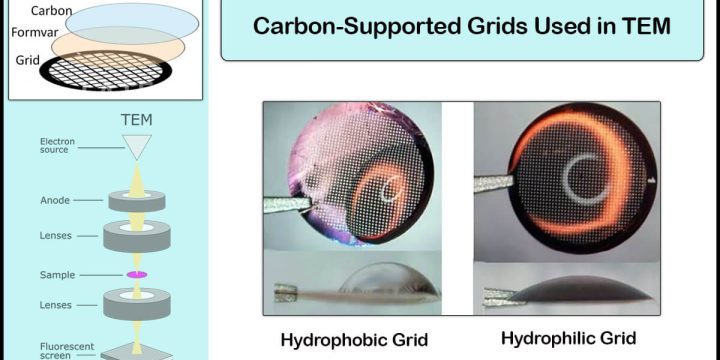
Carbon-Supported Grids Used in Transmission Electron Microscopy (TEM Grids)

Carbon-Supported Grids Used in Transmission Electron Microscopy (TEM Grids)

Report
[vc_row][vc_column width="3/4"][vc_row_inner][vc_column_inner][vc_column_text css=""] Carbon-Supported Grids Used in Transmission Electron Microscopy (TEM Grids) The grids used in TEM microscopes (a type of electron microscope) to place specimens are usually made of copper with a mesh size of about 3 mm and a layer of plastic called a formvar and a thin film of carbon. [/vc_column_text][/vc_column_inner][/vc_row_inner][vc_row_inner css=".vc_custom_1747482666285{background-color: #D9D9D9 !important;}"][vc_column_inner width="1/2"][vc_cta h2="" txt_align="center" style="3d" color="mulled-wine" el_width="xl" add_button="bottom" btn_title="What is an Electron Microscope?" btn_style="3d" btn_color="juicy-pink" btn_align="center" btn_link="url:https%3A%2F%2Fvaccoat.com%2Fblog%2Felectron-microscope%2F|title:What%20is%20an%20Electron%20Microscope%3F|target:_blank"][/vc_cta][/vc_column_inner][vc_column_inner width="1/2"][vc_cta h2="" txt_align="center" style="3d" color="mulled-wine" el_width="xl" add_button="bottom" btn_title="Thin Films" btn_style="3d" btn_color="juicy-pink" btn_align="center" btn_link="url:https%3A%2F%2Fvaccoat.com%2Fblog%2Fthin-film-and-thin-films-types%2F|title:Thin%20Films%20Coating%20and%20Applications|target:_blank"][/vc_cta][/vc_column_inner][/vc_row_inner][vc_row_inner][vc_column_inner width="2/3"][vc_column_text css=""] When the samples are placed on the coated grids, the uniformity of the sample layer is one of the important points for proper imaging of biomolecular complex in aqueous solution. For this purpose, it is necessary that the surface in contact with…
Read More
Material Deposition Table to Select the Appropriate Method of Vacuum Deposition

Material Deposition Table to Select the Appropriate Method of Vacuum Deposition

Uncategorized
[vc_row][vc_column width="3/4"][vc_row_inner][vc_column_inner][vc_column_text css=""] Material Deposition Table to Select the Appropriate Method of Vacuum Deposition Vacuum deposition technology is a wide range of different deposition methods (method of vacuum deposition) that are used to create single or multi thin film layers of several nanometers to several micrometers of different materials and compounds on different surfaces in a high vacuum system and have various applications in industry and research fields. In general, the process of deposition of the thin films in vacuum conditions consists of three main parameters: the target material, the substrate, and the process of transferring the material from the target to the substrate. [/vc_column_text][/vc_column_inner][/vc_row_inner][vc_row_inner css=".vc_custom_1736073724614{background-color: #D9D9D9 !important;}"][vc_column_inner width="1/2"][vc_cta h2="" txt_align="center" style="3d" color="mulled-wine" add_button="bottom" btn_title="Thin Films" btn_style="3d" btn_color="juicy-pink" btn_align="center" btn_link="url:https%3A%2F%2Fvaccoat.com%2Fblog%2Fthin-film-and-thin-films-types%2F|title:Thin%20Films%20Coating%20and%20Applications|target:_blank"][/vc_cta][/vc_column_inner][vc_column_inner width="1/2"][vc_cta h2="" txt_align="center" style="3d" color="mulled-wine" add_button="bottom" btn_title="Ultra High Vacuum Systems"…
Read More
High-Current Electrical Feedthroughs in Coating Systems

High-Current Electrical Feedthroughs in Coating Systems

Report
[vc_row][vc_column width="3/4"][vc_row_inner][vc_column_inner width="1/2"][vc_column_text css=""] What Are Vacuum Feedthroughs? Feedthroughs in a vacuum chamber, enable different components, like electrical cables, cooling water hoses, or mechanical parts to pass through the device, without causing any leakage under high or ultra-high vacuum conditions. Vacuum feedthroughs are useful in various applications, especially where precise pressure control is required, such as thin film deposition systems. [/vc_column_text][/vc_column_inner][vc_column_inner width="1/2"][vc_column_text css=""] [lwptoc backgroundColor="#d6d6d6" borderColor="#5b5b5b" skipHeadingText="Recent Posts|References|Some of Vac Coat Products|Sputter Coater|Carbon Coater|Sputter/Carbon|Thermal"] [/vc_column_text][/vc_column_inner][/vc_row_inner][vc_row_inner css=".vc_custom_1730495958241{background-color: #d9d9d9 !important;}"][vc_column_inner width="1/2"][vc_cta h2="" txt_align="center" style="3d" color="mulled-wine" add_button="bottom" btn_title="Know more" btn_style="3d" btn_color="juicy-pink" btn_align="center" css="" btn_link="url:https%3A%2F%2Fvaccoat.com%2Fblog%2Fthe-importance-of-vacuum-leakage-detection%2F|title:The%20Importance%20of%20Vacuum%20Leakage%20Detection|target:_blank"][/vc_cta][/vc_column_inner][vc_column_inner width="1/2"][vc_cta h2="" txt_align="center" style="3d" color="mulled-wine" add_button="bottom" btn_title="Thin Films" btn_style="3d" btn_color="juicy-pink" btn_align="center" css="" btn_link="url:https%3A%2F%2Fvaccoat.com%2Fblog%2Fthin-film-and-thin-films-types%2F|title:Thin%20Films%20Coating%20and%20Applications|target:_blank"][/vc_cta][/vc_column_inner][/vc_row_inner][vc_row_inner][vc_column_inner][vc_column_text css=""] Depending on its mission, various kinds of feedthroughs can be used in a vacuum system. Vac Coat vacuum coating systems are provided with special features,…
Read More
Chalcogenide Thin Films Deposition | A Complete Overview

Chalcogenide Thin Films Deposition | A Complete Overview

Report, Thin Film
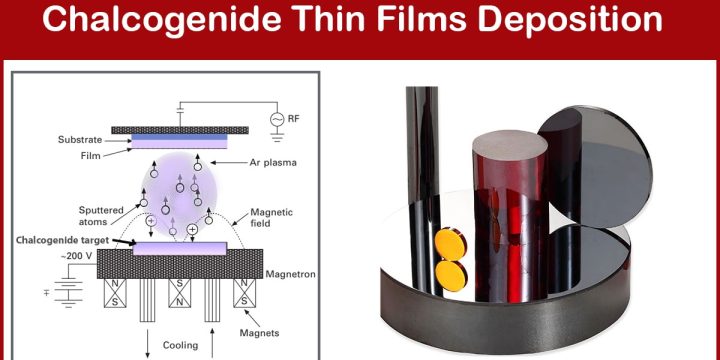
[vc_row][vc_column width="3/4"][vc_row_inner][vc_column_inner][vc_column_text css=""] Chalcogenide Thin Films Deposition Chalcogenides are materials that contain at least one of the chalcogens, elements of group 16 of the periodic table (Sulfur, selenium, tellurium, etc.). Chalcogenide binary, ternary, and quaternary derivatives are widely employed in photovoltaic, photocatalyst, sensor, fuel cell, and battery fabrication. [/vc_column_text][/vc_column_inner][/vc_row_inner][vc_row_inner css=".vc_custom_1718121920208{background-color: #d9d9d9 !important;}"][vc_column_inner width="1/2"][vc_column_text css=""] Chalcogenides’ Properties Chalcogenide compounds, such as transition metal chalcogenides, contain chalcogen anions like S2−, Se2−, or Te2−, and at least an electropositive element. Chalcogenides have a narrow band-gap energy which results in special optical properties of chalcogenide glasses, such as high refractive index, infrared (IR) transparency, nonlinear optical properties, and reversible phase change from amorphous to crystalline. Chalcogenide glasses can be polished or machined into planar, spherical or other shapes for various applications. [/vc_column_text][/vc_column_inner][vc_column_inner width="1/2"][vc_column_text css=""] [lwptoc…
Read More
Thickness Control of Carbon Film in Vacuum Carbon Coaters

Thickness Control of Carbon Film in Vacuum Carbon Coaters

Carbon Coater, Report
[vc_row][vc_column width="3/4"][vc_row_inner][vc_column_inner width="1/2"][vc_column_text css=""] Precise Thickness Control of Carbon Film in Vacuum Carbon Coaters Control of carbon film thickness deposited on the samples to be analyzed by electron microscopy (SEM, TEM, FE-SEM, and etc.) or Energy-dispersive X-ray spectroscopy (EDX) should be accurate to obtain the best result. The QCM monitoring of the thickness of carbon thin film deposition by resistive evaporation of carbon sources (Rod or Fiber) happens at high temperatures that may cause sensor heating and failure. [/vc_column_text][/vc_column_inner][vc_column_inner width="1/2"][vc_column_text css=""] [lwptoc backgroundColor="#d6d6d6" borderColor="#5b5b5b" skipHeadingText="Recent Posts|Some of Vac Coat Products|Sputter Coater|Carbon Coater|SEM Coater|Thermal"] [/vc_column_text][/vc_column_inner][/vc_row_inner][vc_row_inner css=".vc_custom_1736513625084{background-color: #D9D9D9 !important;}"][vc_column_inner width="1/2"][vc_cta h2="" txt_align="center" style="3d" color="mulled-wine" add_button="bottom" btn_title="What is SEM?" btn_style="3d" btn_color="juicy-pink" btn_align="center" btn_link="url:https%3A%2F%2Fvaccoat.com%2Fblog%2Fscanning-electron-microscope-sem%2F|title:Scanning%20Electron%20Microscope%20(SEM)|target:_blank"][/vc_cta][/vc_column_inner][vc_column_inner width="1/2"][vc_cta h2="" txt_align="center" style="3d" color="mulled-wine" add_button="bottom" btn_title="Carbon Coaters" btn_style="3d" btn_color="juicy-pink" btn_align="center" btn_link="url:https%3A%2F%2Fvaccoat.com%2Fcarbon-coater%2F|title:Carbon%20Coaters%20%7C%20Vac%20Coat%20Desk%20Carbon%20Coaters|target:_blank"][/vc_cta][/vc_column_inner][/vc_row_inner][vc_row_inner][vc_column_inner width="1/2"][vc_column_text css=""] Pulsed Carbon Fiber Evaporation Process Pulsed…
Read More
Learn More about Turbomolecular Pumps

Learn More about Turbomolecular Pumps

Report, Vacuum Pumps
[vc_row css=".vc_custom_1622359525694{margin-right: 10px !important;margin-left: 10px !important;}"][vc_column width="3/4"][vc_row_inner][vc_column_inner][vc_column_text] Learn more about Turbomolecular Pumps One of the most commonly used pumps for high vacuum pressure is the Turbomolecular Pump. These pumps are easy to use and require less care and maintenance than diffusion pumps. The small foot print, the lack of need to cool with water, the speed to reach the desired vacuum, the high purity of these pumps are other advantages compared to diffusion pumps. Using these pumps, the pumping speed can be constant with a good accuracy (One of the disadvantages of these pumps is their high price). Turbomolecular pumps can be used in the range of rough vacuum, high vacuum and Ultra-High Vacuum (UHV) with a constant pumping speed of up to 4000 liters per second. [/vc_column_text][/vc_column_inner][/vc_row_inner][vc_row_inner][vc_column_inner width="1/2"][vc_cta h2=""…
Read More
What is the GLAD Sputtering Technique?

What is the GLAD Sputtering Technique?

Report, Sputter Coater, Sputtering
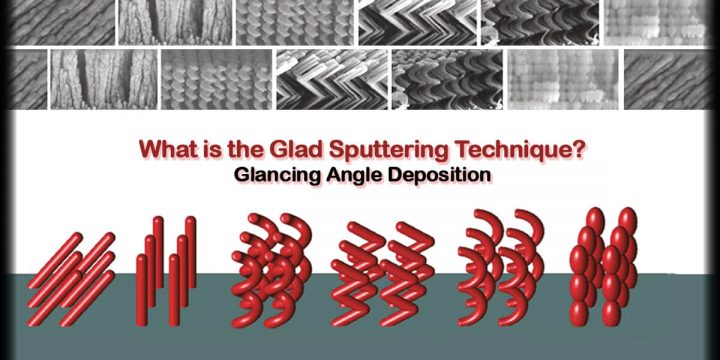
[vc_row][vc_column width="3/4"][vc_row_inner][vc_column_inner][vc_column_text css=""] What is the GLAD Sputtering Technique? There are various techniques for increasing the quality of thin films deposited by vacuum coating methods. GLAD Sputtering (Glancing Angle Deposition) or OLA (Oblique Angle Deposition) is one of the most widely used techniques in the sputtering deposition process. GLAD method helps to achieve different microstructural architectures and increases the surface area of thin films. In the GLAD Sputtering, you could make an array of periodic microstructures to increase the surface sensitivity. [/vc_column_text][/vc_column_inner][/vc_row_inner][vc_row_inner css=".vc_custom_1738928310283{background-color: #D9D9D9 !important;}"][vc_column_inner width="1/2"][vc_video link="https://youtu.be/noHrDL3YUhE" css=""][vc_column_text css=".vc_custom_1738928546355{margin-top: -20px !important;}"] sputtering: a process animation [/vc_column_text][/vc_column_inner][vc_column_inner width="1/2"][vc_cta h2="" txt_align="center" style="3d" color="mulled-wine" add_button="bottom" btn_title="What is Thin Film?" btn_style="3d" btn_color="juicy-pink" btn_align="center" btn_link="url:https%3A%2F%2Fvaccoat.com%2Fblog%2Fthin-film-and-thin-films-types%2F|title:Thin%20Films%20Coating%20and%20Applications|target:_blank"][/vc_cta][/vc_column_inner][/vc_row_inner][vc_row_inner][vc_column_inner][vc_column_text css=""] Although the GLAD technique could apply to various vacuum vapor deposition methods. The DC Magnetron GLAD Sputtering is a…
Read More
Deposition of the Highly Reactive Materials

Deposition of the Highly Reactive Materials

Thermal evaporation
[vc_row][vc_column width="3/4"][vc_row_inner][vc_column_inner][vc_column_text css=""] Deposition of the highly reactive materials There are materials with a high affinity to oxygen among the materials which are deposited by the vacuum coating systems. If these substances are in the vicinity of a small amount of oxygen, they react quickly and burn completely. Lithium is easily oxidized when exposed to air. On the other hand, this alkali metal and its compounds have many applications in the industry. For example, this metal is used to produce rechargeable batteries that are used in smartphones, tablets, etc. The best way to lithium deposition is the thermal evaporation method. [/vc_column_text][/vc_column_inner][/vc_row_inner][vc_row_inner css=".vc_custom_1736077813671{background-color: #D9D9D9 !important;}"][vc_column_inner width="1/2"][vc_cta h2="" txt_align="center" style="3d" color="mulled-wine" add_button="bottom" btn_title="Thermal Evaporation" btn_style="3d" btn_color="juicy-pink" btn_align="center" css="" btn_link="url:https%3A%2F%2Fvaccoat.com%2Fblog%2Fthermal-evaporation-method%2F|title:Thin%20Film%20Deposition%20By%20Thermal%20Evaporation%20Method|target:_blank"][/vc_cta][/vc_column_inner][vc_column_inner width="1/2"][vc_cta h2="" txt_align="center" style="3d" color="mulled-wine" add_button="bottom" btn_title="Sputtering" btn_style="3d" btn_color="juicy-pink" btn_align="center" btn_link="url:https%3A%2F%2Fvaccoat.com%2Fblog%2Fsputtering%2F|title:Sputtering%20Process%20%7C%20Sputtering%20Deposition%20Method|target:_blank"][/vc_cta][/vc_column_inner][/vc_row_inner][vc_row_inner][vc_column_inner][vc_column_text css=""] Lithium…
Read More
Coxem Co has joined the VacCoat worldwide distribution network

Coxem Co has joined the VacCoat worldwide distribution network

News
[vc_row][vc_column width="2/3"][vc_row_inner][vc_column_inner][vc_column_text] Coxem Co has joined the VacCoat worldwide distribution network. Coxem is a Korean manufacturer of scanning electron microscopy (SEM). For electron microscopy imaging, one of the requirements prior to imaging is for a deposit a nanometer thin film of electrically conductive material (usually gold or carbon) onto the object to be imaged. To accommodate this requirement, vacuum deposition systems are used to prepare samples for electron microscopes. [/vc_column_text][/vc_column_inner][/vc_row_inner][vc_row_inner][vc_column_inner width="1/2"][vc_cta h2="" txt_align="center" style="3d" color="mulled-wine" add_button="bottom" btn_title="What is SEM?" btn_style="3d" btn_color="juicy-pink" btn_align="center" btn_link="url:https%3A%2F%2Fvaccoat.com%2Fblog%2Fscanning-electron-microscope-sem%2F|title:Scanning%20Electron%20Microscope%20(SEM)|target:_blank"][/vc_cta][/vc_column_inner][vc_column_inner width="1/2"][vc_cta h2="" txt_align="center" style="3d" color="mulled-wine" add_button="bottom" btn_title="Sample Preparation for SEM?" btn_style="3d" btn_color="juicy-pink" btn_align="center" btn_link="url:https%3A%2F%2Fvaccoat.com%2Fblog%2Fsample-preparation-for-sem%2F|title:Sample%20Preparation%20for%20Scanning%20Electron%20Microscopy|target:_blank"][/vc_cta][/vc_column_inner][/vc_row_inner][vc_separator][vc_row_inner][vc_column_inner width="1/2"][vc_column_text] As a designer and manufacturer of vacuum coating systems, VacCoat Ltd has transferred its product sales representative in China and Korea to Coxem under a contract. Coxem started producing electron microscopes in…
Read More
Plasma Cleaning | What is Plasma Cleaner?

Plasma Cleaning | What is Plasma Cleaner?

Report
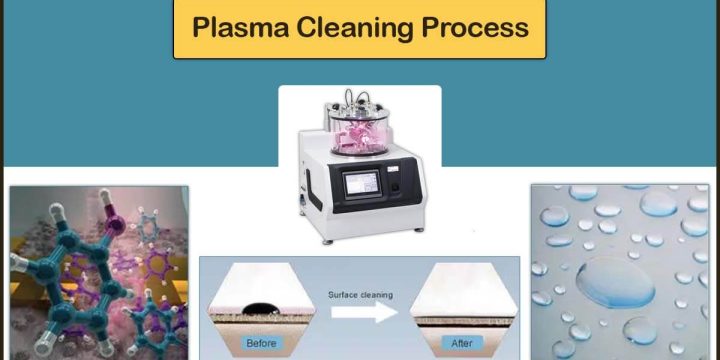
[vc_row][vc_column width="3/4"][vc_row_inner][vc_column_inner][vc_column_text] What is Plasma Cleaning? Surface cleaning using plasma is an economical way to clean specimens uniformly and securely through plasma treatment. Removal of contaminants from the studied substrates without affecting the overall properties of the material is one of the benefits of the plasma surface cleaning method. Plasma cleaning is widely used in the circuit industry, including cleaning the PCB board before coating and cleaning the lead frames during the packaging process. Plasma sample cleaning has significant advantages over other surface cleaning methods as it applies to a wide range of materials, is eco-friendly, residual-free, and effective in highly sensitive applications like cleaning medical equipment. [/vc_column_text][/vc_column_inner][/vc_row_inner][vc_row_inner css=".vc_custom_1714061528273{background-color: #d9d9d9 !important;}"][vc_column_inner width="1/2"][vc_cta h2="" txt_align="center" style="3d" color="mulled-wine" add_button="bottom" btn_title="What is Plasma?" btn_style="3d" btn_color="juicy-pink" btn_align="center" btn_link="url:https%3A%2F%2Fvaccoat.com%2Fblog%2Fwhat-is-plasma%2F|title:What%20is%20Plasma%3F|target:_blank"][/vc_cta][/vc_column_inner][vc_column_inner width="1/2"][vc_cta h2="" txt_align="center" style="3d" color="mulled-wine" add_button="bottom"…
Read More